By Restoration Advertising · 09/29/2026
Mold After Water Damage: Testing and Remediation
Mold can start within a day or two of water damage. When it needs a professional, what testing can and cannot tell you, and what mold remediation actually involves.
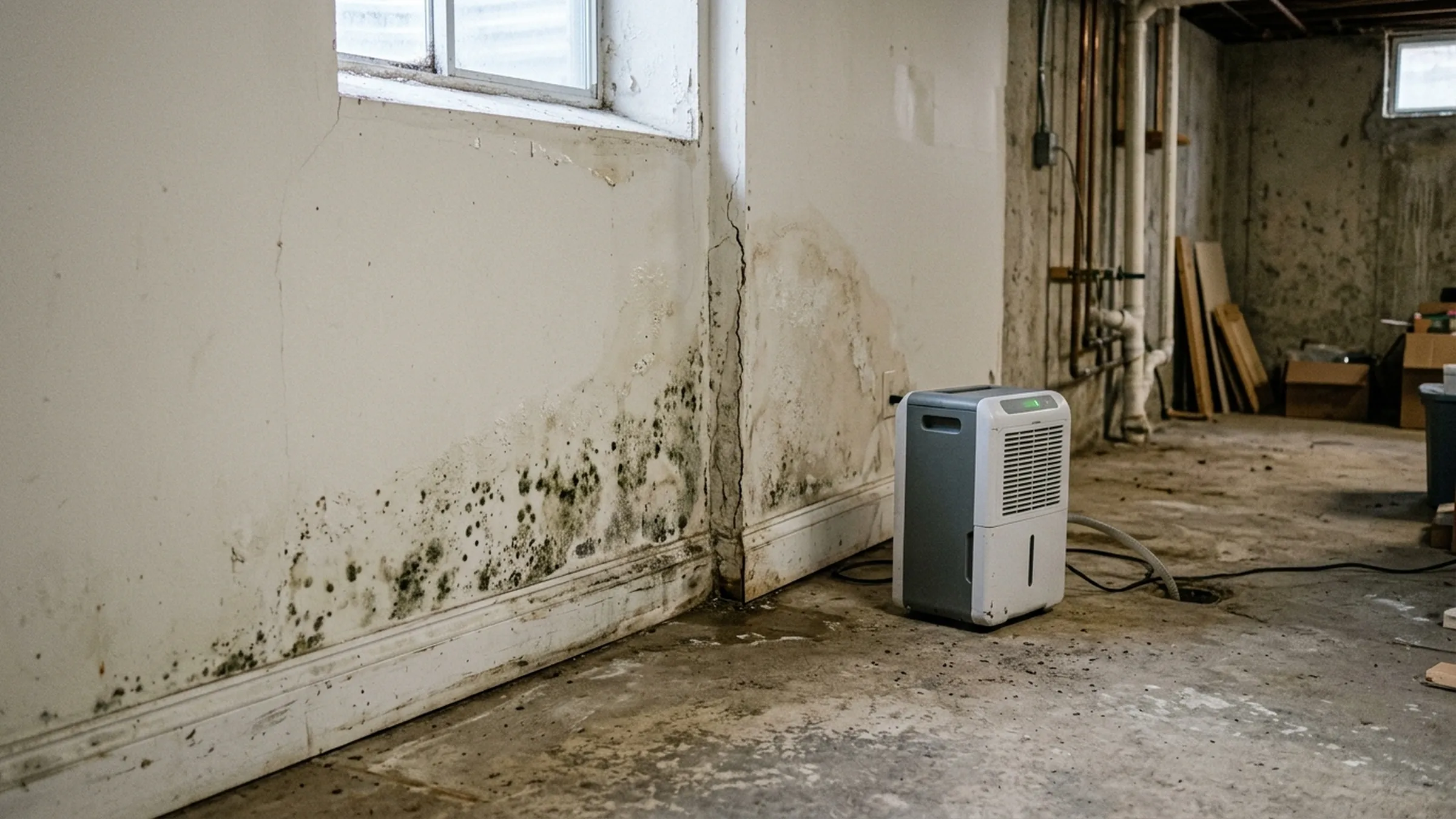
Why does mold follow water damage?
Mold needs moisture, and water damage supplies it. Mold spores are in every house already, so the question after a leak or flood is never whether they are there, only whether the materials stay wet long enough for them to grow.
That is why drying quickly matters more than any cleaning product. The EPA says that if wet or damp materials are dried within 24 to 48 hours after a leak or spill, in most cases mold will not grow (EPA: A Brief Guide to Mold, Moisture, and Your Home, updated February 18, 2026). It also means mold cannot be permanently cleaned away while the moisture is still coming in. Fix the source of the water first, or the mold comes back.
How do you know it is mold?
Look for fuzzy or spotted growth, dark staining on walls, ceilings, grout or the back of drywall, and a musty smell that returns after you clean. Mold often grows where you can't see it: behind wallpaper, under carpet pad, inside wall cavities and above ceiling tiles. A musty smell with no visible source is a reason to look further.
Not every stain is mold. Dirt, soot and old water stains can look alike, which is one reason a professional's inspection is worth more than a guess.
Do you need mold testing?
Usually not. The EPA says that in most cases, if visible mold growth is present, sampling is unnecessary, and that because no federal limits have been set for mold or mold spores, a sample cannot show whether a building meets a federal standard (EPA: A Brief Guide to Mold, Moisture, and Your Home, updated February 18, 2026).
Testing can still help in two situations: a persistent smell with no visible source, and a case where a contract or an insurer wants proof that the work was done. If you do test, many people use a tester who is independent of the company doing the removal, so the same company is not grading its own work.
Can you clean it yourself?
Sometimes. The EPA says that if the moldy area is less than about 10 square feet, less than roughly a 3-foot by 3-foot patch, you can in most cases handle the job yourself (EPA: Mold Cleanup in Your Home, updated June 4, 2026). Scrub hard surfaces with detergent and water, dry them completely, and wear gloves, eye protection and a respirator rated for the job.
Bring in a professional when the area is larger, when the growth came from sewage or floodwater, when it is inside the HVAC system, or when anyone in the house has asthma, allergies or a weakened immune system.
Bleach is not the fix people expect. The EPA says the use of a biocide, chlorine bleach for example, is not recommended as a routine practice during mold cleanup, and warns never to mix bleach with cleaners that contain ammonia, because toxic fumes can result (EPA: A Brief Guide to Mold, Moisture, and Your Home, updated February 18, 2026).
What mold remediation involves
Find and fix the moisture
A leak, a wet crawl space or a humidity problem has to be corrected, or nothing else lasts.
Contain the area
Plastic sheeting and air filtration keep spores from spreading to clean rooms while the work goes on.
Remove what cannot be cleaned
Porous materials such as wet drywall, insulation and carpet pad are usually cut out and bagged rather than scrubbed.
Clean and dry
Remaining surfaces are HEPA-vacuumed and wiped, then dried until moisture readings are normal.
Verify
The company checks that the growth is gone and the materials are dry. Some jobs end with an independent test.
Repair
Only after that are the removed materials replaced. Rebuilding first would seal in a problem.
What should you ask before you hire?
Ask how they will contain the area, what will be removed and what will be cleaned, how they will show that the moisture problem is fixed, and whether the price is in writing. Be careful with a company that promises to make mold "gone forever" without asking where the water came from.
You can browse mold remediation companies in the directory. The directory lists companies and does not vet or rate any of them, so ask the questions above of every company you call.