By Restoration Advertising · 11/25/2026
Will a Frozen Pipe Burst? What Decides It, and What to Do
A frozen pipe does not always burst. Why the split happens under pressure while it freezes, why the water shows up at the thaw, and what to do.
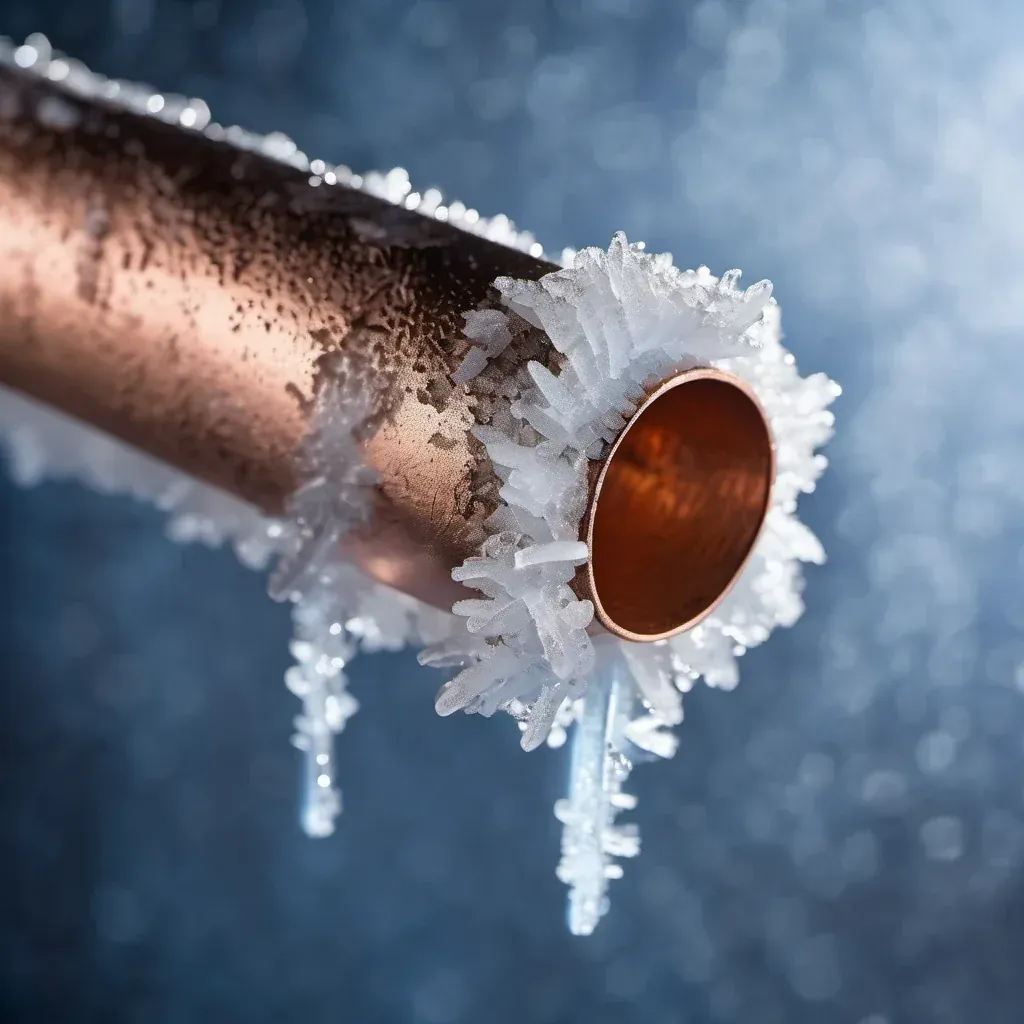
Not every frozen pipe bursts. University of Illinois researchers found the pressure that bursts a pipe builds while the water is freezing, and Texas AgriLife Extension says a frozen pipe "may already be broken" before it thaws. What happens at the thaw is that the ice plug melts and the water comes through a crack that may already be there (Texas AgriLife). The Illinois researchers also found that ice pushing on the pipe wall is not what breaks it; pressure in the trapped water between the ice and a closed faucet is, and a pipe "usually will burst in a place that has almost no ice in it."
That changes what you do. A frozen pipe is a pipe you check after it thaws, with the main valve in your hand.
Why does a pipe burst at all?
Water gets bigger when it freezes, but the Illinois researchers say the ice pushing on the pipe wall is not what splits it: the expansion squeezes the water trapped between the ice and a closed faucet, and that pressure does. The U.S. Geological Survey's Water Density page says the density of ice drops by about 9 percent on freezing, and that ice is about 90 percent as dense as liquid water. Less density means more volume. Our arithmetic from the USGS wording: ice takes up about a tenth more space than the water it came from. The page does not give a volume percentage, so treat "about a tenth" as ours.
A tenth more space is a problem only if the ice has nowhere to push. The University of Illinois News Bureau's release Faucets That Drip Automatically Could End Burst Pipes In Winter (September 4, 1996) explains what happens next:
- Ice forms a plug somewhere along the pipe.
- Freezing continues toward the closed faucet, squeezing the water trapped between the plug and the faucet.
- The release says the pressure of that trapped water climbs from a normal 40 to 50 psi to more than 4,000 psi, at which point a copper pipe is likely to burst. That figure comes from this one 1996 release; we found no second source for the number.
The release's own words are "it is the water pressure that bursts the pipe." The release says a pipe "usually will burst in a place that has almost no ice in it," so the split can be away from the ice you can see (our reading). This section rests on the university's 1996 release, not on the report behind it.
Why does the water show up when it thaws?
Because the ice plug was also the stopper. Texas AgriLife Extension's Winter Storms: Preventing and Thawing Frozen Pipes says the frozen pipe "may already be broken, and it will leak when the water is thawed." Cleveland Water's guide to thawing a frozen pipe (December 2023) says a burst pipe can spew gallons into a home even hours later once the ice has thawed.
So two different moments get confused:
| Moment | What is happening | What you can do |
|---|---|---|
| While freezing | Pressure builds between the plug and a closed tap; a split may form | Open a tap so pressure can escape; Cleveland Water says opening the faucet on the frozen line "will relieve some pressure" |
| At the thaw | The plug melts and water flows through whatever split exists | Know where the main valve is before you thaw |
| Hours after | Water keeps flowing through the split | Check for water in walls, ceilings and under floors |
Two points follow. Our reading of the sources: a dry-looking pipe is not proof it is fine, since Texas AgriLife and Cleveland Water both describe leaks appearing at the thaw. And the damage can be away from the ice: Illinois says a pipe usually bursts where there is almost no ice, which may be out of sight (our reading).
When should you worry, and when not?
Frozen is not the same as burst. No source we read ranks situations by risk, so this table is a rule of thumb that cites the source behind each row where there is one, and the "Lower" and "Moderate" rows are our reading.
| Situation | Worry level | Why |
|---|---|---|
| Exposed pipe in a cold garage, crawl space or attic, water reduced to a trickle | High | Texas AgriLife lists these as the pipes most vulnerable, with outside temperature of 20°F or below |
| Pipe on an exterior wall with little insulation | High | Same list |
| Faucet open and dripping, line cold but flowing | Lower | The Illinois researchers' fix was a faucet that drips as pressure rises, so pipes might freeze but would not burst; an open tap works on the same principle (our reading) |
| Pipe frozen, no sign of damage, thawed with the tap open | Moderate | Our reading: check every other faucet, and the area near the freeze for water |
| Hot water line | Do not assume safe | Texas AgriLife says a hot water line can freeze if water is not moving and the pipe is cold |
The 20°F figure is Texas AgriLife's, and it is where that extension service says pipes "have the potential" to freeze and burst. It is a threshold for risk, not a guarantee in either direction. Keeping the house at 55°F or higher is the figure IBHS FORTIFIED gives for prevention.
Does letting the faucet drip actually help?
Our reading of the Illinois mechanism is yes. Pressure builds because the water between the ice and a closed faucet has nowhere to go, so an open faucet gives it somewhere to go.
The Illinois researchers proposed fixtures that drip on their own when pressure rises, and said the pipes might still freeze but would not burst. IBHS FORTIFIED (January 2023) gives the practical advice: let faucets drip during extreme cold and open cabinet doors that have pipes inside so warm air circulates. Which faucet to leave dripping is our inference: the one served by the pipe most exposed to cold, such as an exterior-wall or garage line. It is not a substitute for insulation or heat.
How can you tell a pipe is frozen?
Cleveland Water lists the signs: no water or only a slight trickle from a faucet, frost on the pipe, or a slight bulge. Treat a trickle as a reason to act now (our advice).
What should you do now?
This guide adds three points to the thawing steps in our live pipes guide:
- Find your main valve first. Texas AgriLife says to know where it is before you thaw, because the pipe may already be broken.
- Keep the faucet on the frozen line open. Texas AgriLife and Cleveland Water both say so; water flowing as it thaws helps melt the rest.
- Check after the thaw. Look at ceilings, walls and cabinet bases for several hours afterward, because Cleveland Water says water can come hours later.
If you use a heat source, Texas AgriLife lists a heating pad, hair dryer, portable space heater and hot towels. It says to make sure electrical cords do not come into contact with water, and never to use a blowtorch, kerosene or propane heater or other open flame, which are fire hazards and release carbon monoxide.
Our guide to frozen and burst pipes: prevention and the first hour covers prevention, the full thawing steps and the first hour after a burst, so this guide leaves them there.
When should you call a professional?
Call a licensed plumber if you cannot find the frozen section, cannot reach it, or cannot get it to thaw. Call a restoration company if water has reached drywall, ceilings or flooring; our guide to the first 24 hours after water damage explains why speed matters. Not sure who to call first? See plumber or restoration company first. Insurance is state- and policy-specific, so read your policy's freezing wording and call your insurer before you decide whether to file.
Researched and drafted with AI, then reviewed and edited by the site's editors.