Directory
Fire and smoke damage restoration companies
After a fire, smoke and soot keep damaging a house long after the flames are out. Fire and smoke restoration covers board-up, soot and odor removal, cleaning of contents, and the water left behind by firefighting.
Listings
- (416) 315-7562
5 Star Cleaning
Richmond Hill, Ontario
- (336) 790-0434
AdvantaClean of the Piedmont
Greensboro, North Carolina
- (888) 421-4119
Belfor Property Restoration
Charleston, South Carolina
- (513) 481-5844
Brock Restoration
Cincinnati, Ohio
- (480) 247-7724
Cardinal Clean LLC.
Phoenix, Arizona
- (800) 892-7124
Clean Care of New England
Cranston, Rhode Island
- (416) 551-8287
CPR24 Restoration
Toronto, Ontario
- (602) 428-6103
Disaster Restoration
Phoenix, Arizona
- (513) 763-2121
Dry Effect
Cincinnati, Ohio
- (941) 358-9055
Expert Water Removal
Bradenton, Florida
- (916) 631-1693
Five Star Restoration & Construction, Inc.
Sacramento, California
Foster's Quality First
San Francisco, California
- (706) 562-8718
Homemaster
West Georgia, Georgia
- (804) 230-7240
MA Williams Drain Cleaning, Plumbing, Heating and Air
Richmond, Virginia
- (713) 686-8899
R&L Global Inc.
Houston, Texas
- (904) 880-6440
Rainbow International Restoration
Jacksonville, Florida
- (808) 745-1608
Rescue One Restoration
Honolulu, Hawaii
- (480) 571-9521
Scottsdale Water Damage Restoration
Scottsdale, Arizona
- (201) 740-2950
SERVPRO of Hoboken/Union City
Jersey City, New Jersey
- (732) 410-7309
SERVPRO of West Somerset County
Belle Mead, New Jersey
- (602) 973-1899
Silverton Contractors Inc.
Phoenix, Arizona
- (312) 574-3814
Water Mold Fire Restoration of Chicago
Chicago, Illinois
- (972) 559-4244
Water Mold Fire Restoration of Dallas
Dallas, Texas
- (305) 999-5144
Water Mold Fire Restoration of Miami
Miami, Florida
- (651) 395-7036
Water Mold Fire Restoration of Minneapolis
Minneapolis, Minnesota
- (202) 650-0299
Water Mold Fire Restoration of Washington DC
Washington DC, District of Columbia
From a burned-out kitchen to a working one
Illustrations made for this site, not work by the companies listed.
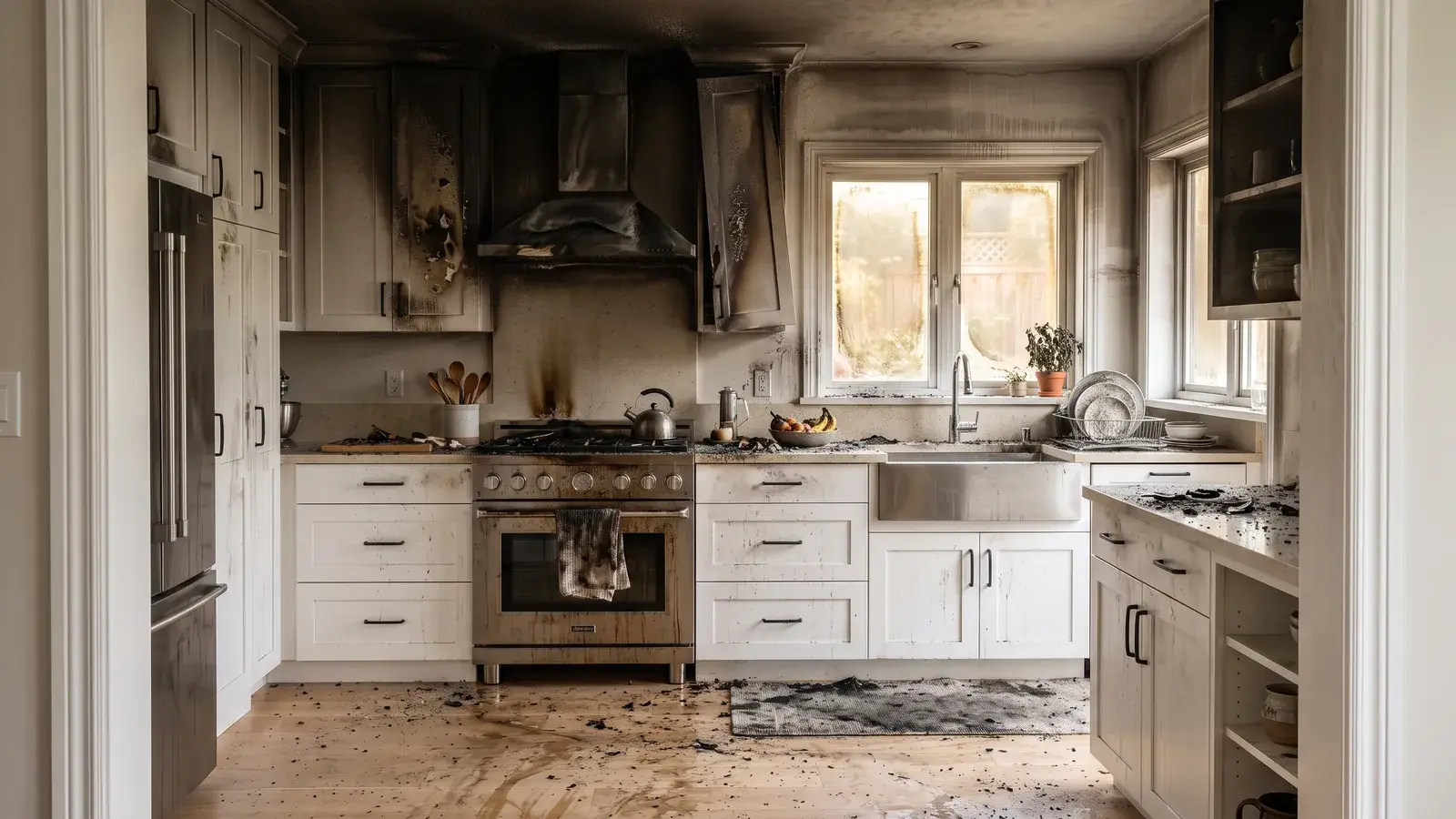

When fire takes the kitchen... Smoke out. Home back.
What happens first
- Wait until it is safe. Do not go back in until the fire department says it is safe, and do not try to reconnect utilities yourself: the fire department should make sure they are safe or disconnected.
- Secure the house. Broken windows, doors and holes in the roof are boarded up and tarped, to keep out weather and intruders. Most fire restoration companies do this as their first visit.
- Document and call your insurer. Take photos and video of every room, make an inventory, and do not throw anything away until you have made it. Ask your insurer what your policy covers while you are out of the house.
- Dry out. The water used to put the fire out has to be removed and dried like any other water damage, or mold can follow.
- Clean, deodorize, rebuild. Soot is cleaned from surfaces, contents are cleaned or listed as lost, smoke odor is treated, and what burned is rebuilt.
Why not wipe the soot yourself? Soot smears easily and can stain further when rubbed. It is also acidic, so left in place it can go on discoloring and corroding surfaces for days after the fire, which is why cleanup usually starts quickly.
What Ready.gov says to do after a fire
These points are linked to the page we read on 10/05/2026, with the date that page shows. They are general guidance, not advice for your home. In an emergency, call 911.
- Shelter and relief. "Contact your local disaster relief service, such as The Red Cross, if you need temporary housing, food and medicines." (Ready.gov, home fires, updated 02/26/2026)
- Safe to enter. "Check with the fire department to make sure your residence is safe to enter." (same page)
- Utilities. "DO NOT attempt to reconnect utilities yourself. The fire department should make sure that utilities are either safe to use or are disconnected before they leave the site." (same page)
- Inventory. "Conduct an inventory of damaged property and items. Do not throw away any damaged goods until after you make the inventory of your items." (same page)
- Receipts. "Begin saving receipts for any money you spend related to fire loss." (same page)
- Your mortgage company. "Notify your mortgage company of the fire." (same page)
Home fires by the numbers
The US Fire Administration, part of FEMA, reports 344,600 fires, 2,890 deaths, 10,400 injuries and $11,266,200,000 in dollar loss for 2023. From 2014 to 2023 it reports "A 6% decrease in fires" and "A 5% increase in deaths." (USFA, residential fires, page last reviewed February 14, 2025.) These are all residential fires nationwide, not only the ones that need a restoration company.
Where to get help
- 211. 211, run by United Way, says: "211 connects you to expert, caring help." Disaster recovery is one of the kinds of help it lists.
- Ready.gov, home fires.
Sources
Each page was read on 10/05/2026; the date is the one the page shows.
- Ready.gov, "Home fires," updated 02/26/2026.
- US Fire Administration, "Residential fires," page last reviewed February 14, 2025.
- 211.org, undated.
Questions to ask before you hire
Can you board up and secure the house today?
An open house is exposed to rain and to theft. Ask whether the company handles emergency board-up and roof tarping, and how soon.
How will you handle our belongings?
Many fire restoration companies pack out contents to clean them off-site and keep an inventory of what was damaged. Ask how items are tracked, cleaned and stored, and how you will see that inventory.
How will you remove the smoke odor, and how will we know it is gone?
Odor lingers in drywall, insulation, ductwork and fabrics. Ask what the company will clean or remove, and what it will treat, before rebuilding closes the walls.
Are your technicians certified?
The IICRC's Fire and Smoke Restoration Technician course is the usual credential for this work. Ask whether the crew coming to your home holds it.
Will you work with my insurance company?
Most restoration companies do, and many bill the insurer directly. Ask for a written estimate, and check with your insurer before signing anything that assigns your claim to the company.
Does Restoration Advertising check these companies?
No. The companies supplied their own listings, and the directory does not rate, rank or vet them. That is why the questions above are worth asking whoever you call.