Directory
Mold remediation and removal companies
Mold follows water that was not dried in time, and it can hide behind drywall and under floors. Remediation companies test the air and surfaces, contain the affected area, remove what cannot be cleaned, and treat what is left.
Listings
- (416) 315-7562
5 Star Cleaning
Richmond Hill, Ontario
- (678) 831-8466
Atlanta Restoration Service
Atlanta, Georgia
- (888) 421-4119
Belfor Property Restoration
Charleston, South Carolina
- (513) 481-5844
Brock Restoration
Cincinnati, Ohio
- (480) 247-7724
Cardinal Clean LLC.
Phoenix, Arizona
- (800) 892-7124
Clean Care of New England
Cranston, Rhode Island
- (416) 551-8287
CPR24 Restoration
Toronto, Ontario
- (602) 428-6103
Disaster Restoration
Phoenix, Arizona
- (513) 763-2121
Dry Effect
Cincinnati, Ohio
- (770) 284-4791
Emergency Mitigation Specialist
Jenkinsburg, Georgia
- (941) 358-9055
Expert Water Removal
Bradenton, Florida
- (689) 220-7211
Florida Mold Masters of Orlando
Orlando, Florida
- (714) 912-7236
H2O Mold Restoration Gurus of Costa Mesa
Costa Mesa, California
- (714) 671-8603
H2O Mold Restoration Gurus of Santa Ana
Santa Ana, California
- (416) 252-5959
IBX Services
Toronto, Ontario
- (770) 966-9987
Integrity Restoration & Remodeling Contractors LLC
Marietta, Georgia
- (858) 375-1114
La Jolla Mold Testing
La Jolla, California
- (804) 230-7240
MA Williams Drain Cleaning, Plumbing, Heating and Air
Richmond, Virginia
- (203) 283-3912
MoldStar Remediation
Atlanta, Georgia
- (985) 283-3251
New Orleans Mold Remediation
New Orleans, Louisiana
- (770) 415-8947
Provision Construction
Buford, Georgia
- (703) 952-3234
Pure Maintenance Of Washington D.C.
Falls Church, Virginia
- (904) 880-6440
Rainbow International Restoration
Jacksonville, Florida
- (613) 727-7070
Rernovco Ottawa
Ottawa, Ontario
- (360) 667-1665
Robinson Restoration
Vancouver, Washington
- (480) 571-9521
Scottsdale Water Damage Restoration
Scottsdale, Arizona
- (201) 740-2950
SERVPRO of Hoboken/Union City
Jersey City, New Jersey
- (323) 546-4897
Superstratum
Los Angeles, California
- (773) 885-8528
The CleanUP Guys
Chicago, Illinois
- (561) 264-8193
Water Damage Boca Experts
Boca Raton, Florida
- (312) 574-3814
Water Mold Fire Restoration of Chicago
Chicago, Illinois
- (972) 559-4244
Water Mold Fire Restoration of Dallas
Dallas, Texas
- (305) 999-5144
Water Mold Fire Restoration of Miami
Miami, Florida
- (651) 395-7036
Water Mold Fire Restoration of Minneapolis
Minneapolis, Minnesota
- (202) 650-0299
Water Mold Fire Restoration of Washington DC
Washington DC, District of Columbia
From mold on the walls to a clean, dry room
Illustrations made for this site, not work by the companies listed.
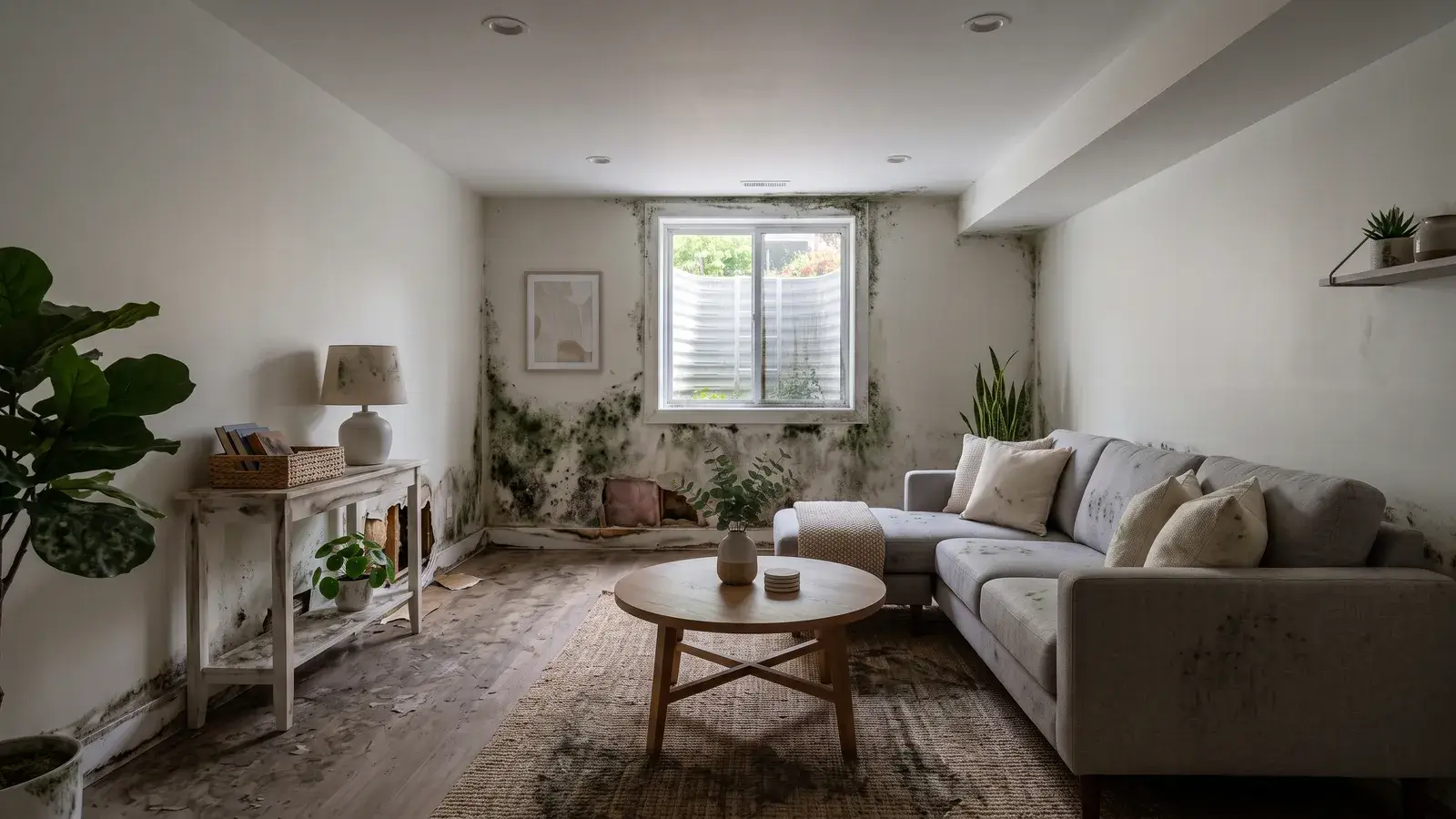

When mold moves in... Every room
What remediation involves
- Find and fix the moisture. Mold grows where water is: a leak, a flood that was not dried in time, or damp air. Until the source is fixed, removed mold comes back.
- Contain the area. The crew seals it off with plastic sheeting and runs air filtration so spores are not spread through the house during the work.
- Remove what cannot be cleaned. Drywall, insulation, carpet and other porous materials with mold growing in them are cut out and bagged.
- Clean and dry what stays. Hard surfaces are cleaned and vacuumed with HEPA equipment, and the area is dried out.
- Check the result before walls are closed up, starting with a visual check that the area is clean and dry. The CDC says it does not recommend mold testing, so ask what a test would tell you.
How big is too big to clean yourself? The US EPA's guidance is that a homeowner can often handle an area under about ten square feet, roughly three feet by three feet, if the moisture problem is fixed; larger areas, or mold after sewage or flood water, call for a professional. Painting over mold or spraying bleach on it does not solve it: the moisture and the growth both have to go. The CDC lists people with asthma, mold allergies, weakened immune systems and chronic lung disease as more at risk, so they are the ones to keep out of the area while the work is done.
What the federal agencies say about mold
These points come from federal agencies and are linked to the page we read on 10/05/2026, with the date that page shows. They are general guidance, not advice for your home.
- Moisture is the key. The EPA says: "The key to mold control is moisture control." (EPA, a brief guide to mold, moisture and your home, updated February 18, 2026)
- How fast to dry. The EPA says: "It is important to dry water-damaged areas and items within 24-48 hours to prevent mold growth." The CDC's cleaning guidance says: "Clean up and dry your home quickly after the storm or flood ends- within 24 to 48 hours if possible" (CDC, guidelines for cleaning safely after a disaster, reviewed August 26, 2026), while its mold-prevention page says: "Clean and dry wet items within 48 to 72 hours" (CDC, preventing mold, reviewed August 26, 2026). The sources give different windows, so dry as fast as you can.
- Mold cannot be removed entirely. The EPA says it is impossible to get rid of all mold and mold spores indoors. (EPA brief guide)
- Do not paint over it. The EPA says: "Do not paint or caulk moldy surfaces." (EPA, mold cleanup in your home, updated June 4, 2026)
- Bleach is not a routine step. The EPA says using biocides such as chlorine bleach "is not recommended as a routine practice during mold cleanup," and: "Never mix chlorine bleach solution with other cleaning solutions or detergents that contain ammonia because toxic fumes could be produced." (EPA brief guide)
- Testing. The CDC says: "CDC does not recommend mold testing." (CDC, about mold, updated September 26, 2024)
- Who is more at risk. The CDC lists people with asthma, people who are allergic to mold, people with weakened immune systems and people with chronic lung disease. (CDC, about mold)
- Protect yourself. The CDC says to put on "an N95 respirator mask, goggles, and protective gloves" before cleaning up mold (CDC, returning home, April 30, 2026).
- After flood or sewage water. The EPA says to "call in a professional who has experience cleaning and fixing buildings damaged by contaminated water." (EPA, mold cleanup in your home)
Where to get help
- EPA, mold cleanup in your home and CDC, about mold.
- 211. 211, run by United Way, says: "211 connects you to expert, caring help." Disaster recovery is one of the kinds of help it lists.
Sources
Each page was read on 10/05/2026; the date is the one the page shows.
- EPA, "A brief guide to mold, moisture and your home," updated February 18, 2026.
- EPA, "Mold cleanup in your home," updated June 4, 2026.
- CDC, "About mold," updated September 26, 2024.
- CDC, "Preventing mold," reviewed August 26, 2026.
- CDC, "Returning home after a natural disaster," April 30, 2026.
- CDC, "Guidelines for cleaning safely after a disaster," reviewed August 26, 2026.
- 211.org, undated.
Questions to ask before you hire
Will you find what caused the mold?
Remediation without fixing the moisture source is temporary. Ask whether the company will find the cause, and who will repair it: some remediators fix leaks, others will tell you which trade to call.
Who does the testing, you or someone independent?
The CDC says it does not recommend mold testing, so ask first what a test would tell you that a visual check would not. If a test is done, some homeowners prefer an independent assessor, so the company doing the removal is not also grading it.
Are your technicians certified?
The IICRC's Applied Microbial Remediation Technician course is the usual credential for mold remediation. Ask whether the crew coming to your home holds it.
How will you contain the work?
Ask how the area will be sealed off and how the air will be filtered, so spores are not carried into the rest of the house.
Is mold covered by my insurance?
Coverage for mold varies widely. Many policies limit it, or cover it only when it follows a sudden event the policy covers, such as a burst pipe. Check your policy and ask your insurer before work starts.
Does Restoration Advertising check these companies?
No. The companies supplied their own listings, and the directory does not rate, rank or vet them. That is why the questions above are worth asking whoever you call.